
Step inside a real sumo stable at dawn. Watch wrestlers train, hear their bodies collide, and understand why this is the most authentic sumo experience in Japan.
Book Morning Practice Tour ➔ⓘ Disclaimer This website is an independent guide, not affiliated with any sumo stable or the Japan Sumo Association. Tour details sourced from third-party platforms. Verify before booking.
| Experience | Guided morning practice visit at a Tokyo sumo stable (heya) |
|---|---|
| Price Range* | Approx. $40–$70 per person |
| Duration | ~2–3 hours (including travel and briefing) |
| Start Time | Typically 7:00–7:30 a.m. |
| Meeting Point | Usually near Ryogoku Station (exact location confirmed after booking) |
| Advance Booking | Essential — stables have strict visitor limits (often 20–30 people) |
| Age Recommendation | 12+ (due to early start, silence requirements, floor seating) |
*Prices sourced from third-party booking platforms as of 2026.
Asageiko (朝稽古) literally translates to "morning training." It's the core daily routine of every professional sumo wrestler in Japan. From roughly 5 a.m. to 11 a.m., wrestlers in each heya (stable) perform a rigorous sequence of drills, sparring, and conditioning exercises that has remained largely unchanged for centuries.
What makes this special for visitors: you sit on the floor of the actual training hall, mere meters from the action. There's no stage, no barrier, no commentary. Just the sound of skin slapping skin, the thud of a 140 kg body hitting the clay, and the sharp commands of the stable master. It is, without exaggeration, the most authentic sumo experience available to the public.
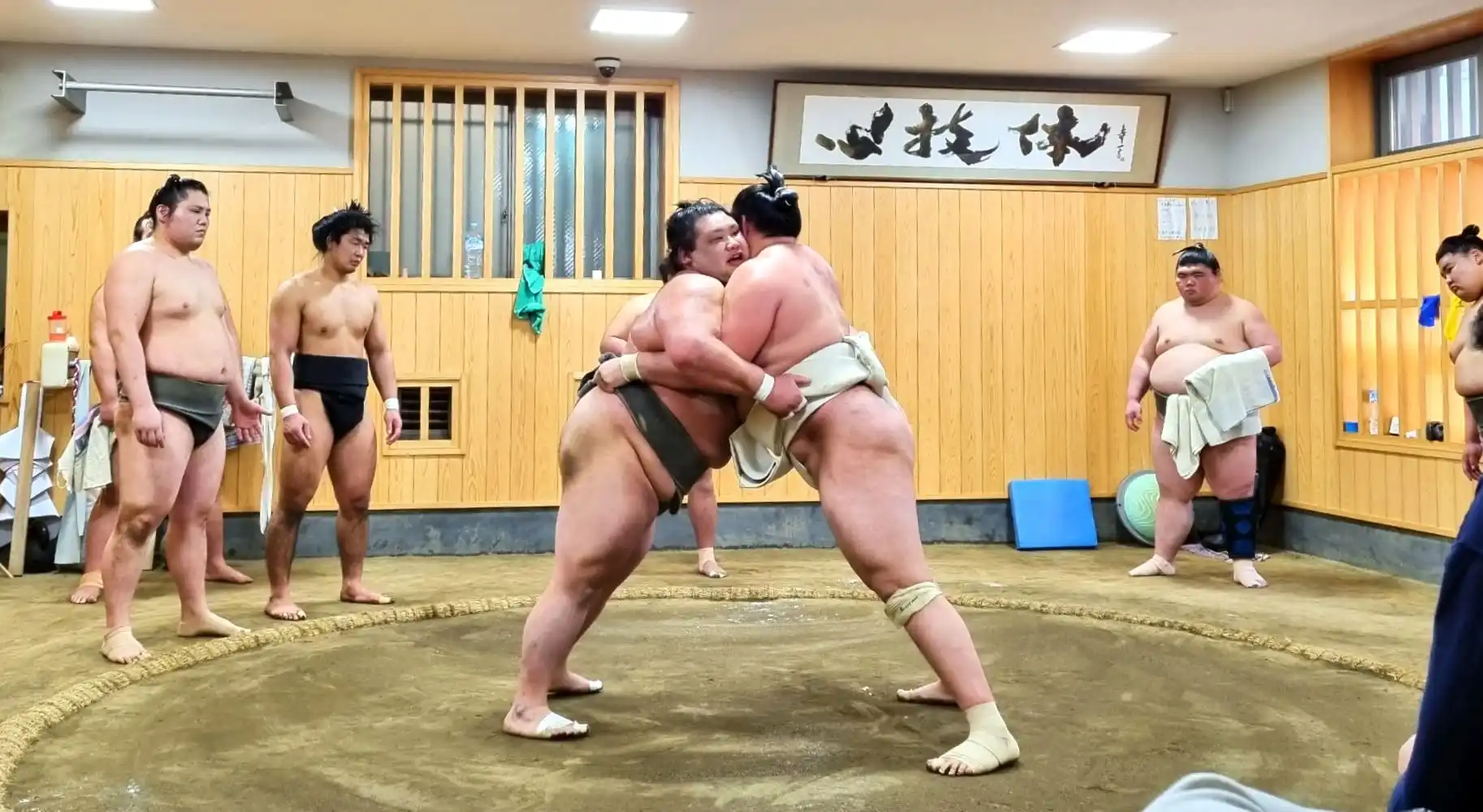
The training follows a strict hierarchy-based schedule. Here's what you'll typically witness:
Lower-ranked wrestlers (jonokuchi through sandanme) train first. This is when you'll see the most volume — young wrestlers doing repetitive butsukari-geiko (collision drills) where one wrestler charges repeatedly into another who braces at the ring's edge. It's physically brutal and deeply revealing of sumo's apprentice culture.
Makushita and juryo wrestlers enter the ring. The technique becomes visibly more refined. You'll notice these wrestlers have more defined strategies — some specialize in belt grips (yotsu-zumo), others in pushing and thrusting (oshi-zumo).
The top-division wrestlers (makuuchi) train last. If the stable has a sekiwake, ozeki, or yokozuna, this is when they appear. Their presence changes the room's energy completely. Every other wrestler sits straighter, bows deeper, moves faster.
Wrestlers perform matawari (the full splits), shiko (leg stomps), and other flexibility exercises. This is often when you can get the closest view of individual wrestlers — they're less intense and occasionally make eye contact with visitors.
The moment that stays with me: a 19-year-old junior wrestler being thrown to the ground for the eighth consecutive time, getting up each time without complaint, resuming his stance, and charging again. No coach told him to stop. No one cheered him on. He just kept going. That's sumo distilled to its essence — endurance as character.
— Editorial Team, SumoExperience.tokyo| Feature | Guided Tour | Independent Visit |
|---|---|---|
| Booking process | Book online in English | Contact stable directly (Japanese required) |
| English commentary | ✓ Guide explains techniques, hierarchy, culture | ✗ No commentary |
| Guaranteed entry | ✓ Pre-arranged with the stable | Depends on stable's mood that day |
| Etiquette guidance | ✓ Guide briefs you on rules | You need to research in advance |
| Cost | ~$40–$70 | Free (some stables accept donations) |
| Availability | Scheduled dates, bookable in advance | Unpredictable; stables can close to visitors without notice |
If your guide says "meet at 7:15," be there at 7:05. Stables run on punctuality. Arriving late doesn't just inconvenience your guide — it disrespects the stable master who agreed to open his training hall. Late arrivals may be turned away entirely.
This is the hardest part for many Western visitors. You'll be seated on the floor (hard floor, not tatami) for 1.5–2 hours. You cannot get up to stretch, walk around, or use the bathroom. Bring a small cushion if your knees protest. Cross-legged is acceptable; seiza (kneeling) is ideal but not mandatory.
If photography is permitted (your guide will confirm), use a silent shutter mode. No flash, no video sound, no lens clicks echoing through the hall. The best shots come during butsukari-geiko — the collision drills produce dramatic spray of sand and sweat.
Most stables train Monday through Saturday. Sunday is typically a rest day. Some stables also rest on Wednesday. Your tour operator will schedule around the specific stable's calendar.
Most guided tours end by 9:30–10:00 a.m., leaving you in Ryogoku with a full day ahead. Here's what to do:
Guided tours typically work with 2–3 partner stables and confirm the specific one a few days before your visit. This flexibility allows them to guarantee access even if one stable closes unexpectedly. Most are in the Ryogoku or Morishita area.
Technically yes, but it's becoming increasingly difficult. You'll need to contact the stable in Japanese, follow strict etiquette protocols, and accept that you may be turned away at the door. A guided tour removes all these uncertainties.
During practice, no. Wrestlers are focused and speaking to visitors would be inappropriate. After practice ends, some guided tours arrange brief interactions, but this is not guaranteed. Wrestlers may acknowledge you with a nod or bow as they leave the training area.
Most tour operators recommend ages 12+. The 6–7 a.m. start, combined with 1.5–2 hours of required silence and floor sitting, is challenging for younger children. If your child is exceptionally patient and interested in sumo, contact the tour operator to discuss.
Stables occasionally cancel practice without notice (stable master's decision, wrestler illness, etc.). Reputable tour operators will reschedule you to another stable or another date, or offer a full refund. This is a key advantage of booking through a platform with cancellation protection.