Quick Summary
| Venue | Shinjuku Sumo Club, Shinjuku-ku, Tokyo |
|---|
| Price Range* | Approx. $55–$95 per person (show + chankonabe) |
|---|
| Duration | ~1.5–2 hours |
|---|
| Show Format | Interactive sumo demonstrations + chankonabe meal |
|---|
| Advance Booking | Strongly recommended — high demand in Shinjuku |
|---|
| Location | Walking distance from Shinjuku Station & major hotels |
|---|
| Child-Friendly | Yes — families welcome |
|---|
*Prices sourced from GetYourGuide and other booking platforms as of 2026.
What Makes Shinjuku Sumo Club Different
Most sumo experiences in Tokyo cluster around Ryogoku, the historic sumo district on the east side of the city. Shinjuku Sumo Club takes a different approach: it brings the show to where international visitors actually stay. Shinjuku is home to more major hotels than any other Tokyo neighborhood — the Park Hyatt, Hilton Tokyo, Keio Plaza, Hyatt Regency, and dozens of business hotels are all within a 5 to 20 minute walk of the venue. For travelers staying in west Tokyo, that's a meaningful difference: no 40-minute subway ride, no transfers, no lost time.
The format is similar to what you'll find at Asakusa Sumo Club — live demonstrations by working or recently retired wrestlers, audience participation, and a chankonabe meal — but the atmosphere leans into Shinjuku's urban character. Think neon-lit Tokyo nightlife rather than temple-district tradition. The venue tends to run more evening sessions to align with after-work and post-shopping schedules.
If you're choosing between venues, the rule of thumb is simple: Asakusa for combining sumo with Senso-ji and old Tokyo, Shinjuku for combining sumo with skyscrapers, izakaya, Kabukicho, and the Tokyo many travelers actually inhabit during their trip.
What to Expect: The Full Shinjuku Sumo Club Experience
The Sumo Show
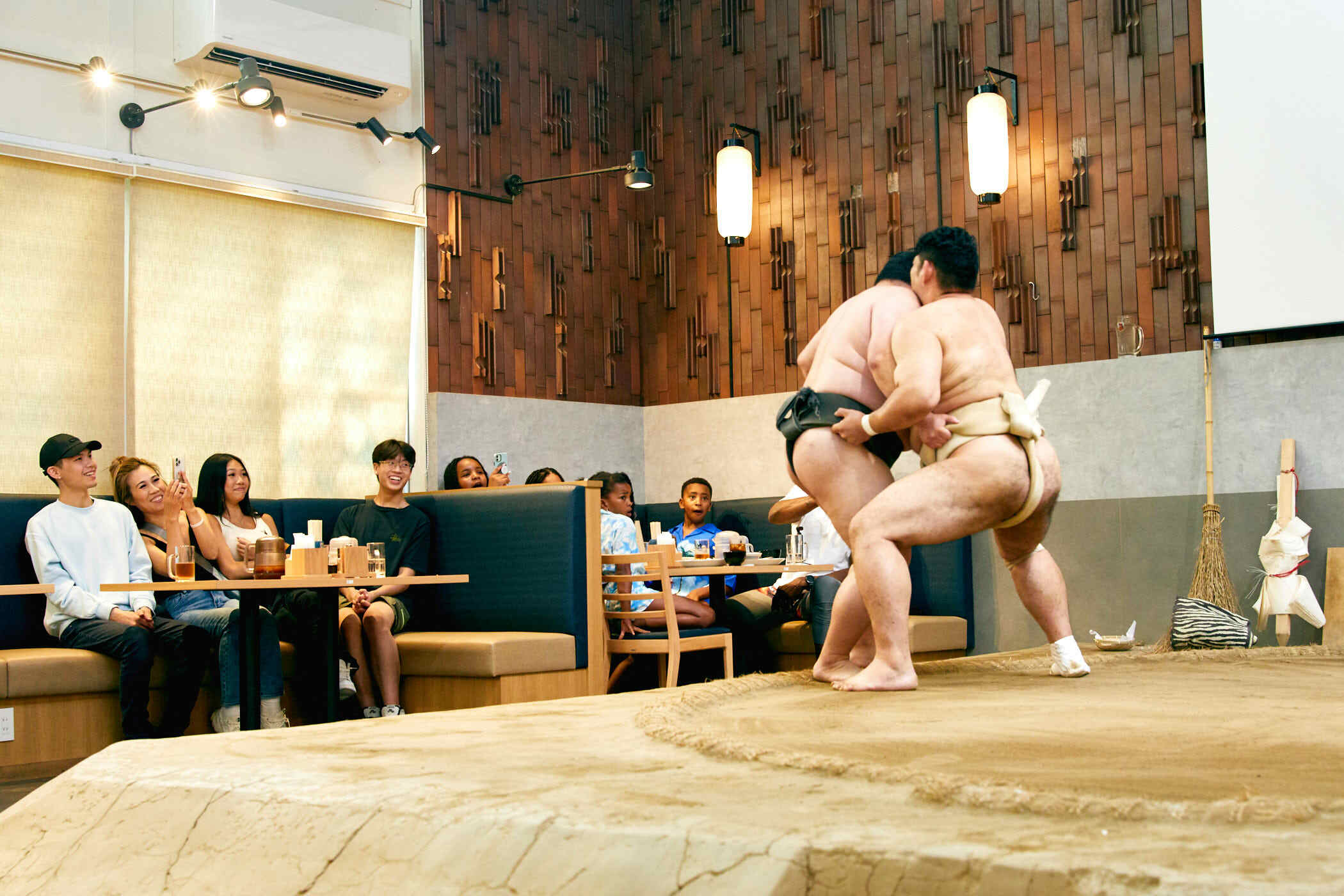
The show is paced to entertain in roughly an hour, with cultural depth built into each segment:
- Introduction to sumo: A bilingual host walks through the history, rules, and rituals — the salt-throwing purification (shio-maki), the leg-stomping (shiko), and the meaning of the loincloth (mawashi). It's a crash course that lasts about 10 minutes.
- Technique demonstrations: Wrestlers showcase a curated set of the 82 official winning techniques (kimarite). Expect to see yorikiri (force-out), uwatenage (overarm throw), tsukiotoshi (thrust down), and hatakikomi (slap-down) explained step by step.
- Exhibition matches: Two full-speed bouts between the performers. The closeness of the seating means you feel the impact — sumo at this range is louder and more physical than televised matches suggest.
- Audience challenge: Volunteers step into the dohyo and try to push a wrestler out. It is, predictably, impossible. The point is the experience: gripping a mawashi, feeling the wrestler's center of gravity, and laughing while everyone films you.
- Photo session: Wrestlers pose with guests afterwards. Standing shoulder to belly with someone twice your weight makes for a great profile picture.
The Chankonabe Meal
Chankonabe at Shinjuku Sumo Club follows the classic recipe served in real sumo stables:
- Broth: Chicken-based (tori) — traditional because chickens stand on two feet, a lucky symbol for wrestlers who lose the moment anything other than their feet touches the ground.
- Proteins: Chicken, tofu, fish cakes, and chicken meatballs (tsukune).
- Vegetables: Napa cabbage, carrots, mushrooms, leeks, and seasonal greens.
- Finish: Udon or rice added at the end to soak up the concentrated broth — arguably the best bite of the meal.
The pot is shared. A single competing sumo wrestler eats 7,000 to 10,000 calories per day, and chankonabe is the backbone of that diet. You won't match that volume, but you'll understand the appeal: it's protein-dense, warming, and built for sharing.
What I like about the Shinjuku location is how easy it is to fold into a normal evening. Dinner in Shinjuku is already on most people's itinerary — making that dinner chankonabe with a live sumo show in front of you is a much higher-yield use of two hours than another anonymous izakaya. If you're staying in west Tokyo, the convenience tips this venue ahead of Ryogoku for most travelers.
— Editorial Team, SumoExperience.tokyo
Ticket Comparison: Show Only vs. Show + Chankonabe
| Feature |
Show Only |
Show + Chankonabe |
| Live sumo demonstrations |
✓ |
✓ |
| Audience participation |
✓ |
✓ |
| Chankonabe meal |
✗ |
✓ |
| Photo session |
✓ |
✓ |
| Duration |
~1 hour |
~1.5–2 hours |
| Price |
Lower |
Higher (includes meal) |
💡 Our Recommendation
Go for the chankonabe package. Shinjuku has thousands of restaurants, but eating the wrestlers' own stew immediately after watching them compete is the kind of single coherent experience you'll talk about later. The marginal cost over show-only is small compared to a separate Shinjuku dinner.
Insider Tips for Shinjuku Sumo Club
Best Time Slots
- Early evening (around 6 p.m.): The most popular slot. Books out first — reserve 1-2 weeks ahead in peak season.
- Later evening (around 8 p.m.): A more relaxed, lively crowd. Pair with a Shinjuku nightlife plan afterwards.
- Lunch slots (where offered): Quieter and easier to book on short notice.
Combine with a Shinjuku Day
The venue's location makes it easy to chain into a full Shinjuku itinerary:
- Morning: Shinjuku Gyoen National Garden (15 min walk from Shinjuku Station)
- Late morning: Observation deck at the Tokyo Metropolitan Government Building (free)
- Lunch: Omoide Yokocho or any of Shinjuku's lunch spots
- Afternoon: Shopping around Isetan, Lumine, or NEWoMan
- Evening: Shinjuku Sumo Club (show + chankonabe)
- Late evening: Walk through Kabukicho or the Golden Gai alleys
How to Save on Shinjuku Sumo Club Tickets
- Book on GetYourGuide: GetYourGuide typically offers competitive pricing with instant confirmation and flexible cancellation on most slots.
- Weekday sessions: Pricing can be lower on weekday evenings than on weekend prime time.
- Child rates: Reduced rates for children are usually available — check the booking platform for age cutoffs.
- Combo deals: Some platforms bundle Shinjuku Sumo Club with other Tokyo activities (Tokyo Skytree, a teamLab ticket, a Shibuya food tour) at a discount.
Getting There
- Nearest station: Shinjuku Station (JR Yamanote, Chuo, Sobu, Saikyo, Shonan-Shinjuku, Odakyu, Keio, Tokyo Metro Marunouchi, Toei Shinjuku & Oedo lines).
- From Tokyo Station: JR Chuo Line Rapid to Shinjuku (~14 minutes).
- From Haneda Airport: Airport Limousine Bus direct to Shinjuku (~50 minutes), or Keikyu + JR transfer (~55 minutes).
- From Narita Airport: Narita Express (N'EX) direct to Shinjuku (~85 minutes).
- From Shibuya: JR Yamanote Line, 2 stops (~6 minutes).
- From Asakusa: Toei Asakusa Line + transfer at Higashi-Ginza or Daimon (~30 minutes).
Shinjuku Sumo Club vs. Other Sumo Experiences
Honest take on how Shinjuku Sumo Club compares to the alternatives:
- Choose Shinjuku Sumo Club if: You're staying in west Tokyo, you want an evening sumo experience without crossing the city, or you want to combine sumo with Shinjuku nightlife and skyscraper views.
- Choose Asakusa Sumo Club if: You're already visiting Senso-ji and the old-Tokyo district, or you want a more traditional cultural setting.
- Choose Yokozuna Tonkatsu if: You prefer tonkatsu over hot pot and want a slightly more performance-driven show in Ryogoku.
- Choose Morning Practice if: You want to see real, unstaged training inside a sumo stable — no narration, no audience involvement, just the sport.
- Looking for everyday sumo dining? See our sumo restaurant guide or the Kyushu Basho ticket guide for the real tournaments.
Etiquette
- Photos: Generally allowed during the show and definitely during the photo session. Flash is usually discouraged during bouts.
- Audience participation: Optional. If you don't want to step into the ring, you won't be pulled in against your will.
- Touching wrestlers: During the photo session only, and following the host's lead.
- Footwear: The dohyo area is sacred — you may be asked to remove shoes if you enter it. Easy slip-on shoes are recommended.
Frequently Asked Questions
Do I need to book Shinjuku Sumo Club in advance?
Yes. Shinjuku has the highest hotel concentration in Tokyo and the venue books out quickly — especially evening slots on weekends and during cherry blossom season (March-April) and autumn foliage season (October-November). Booking 1-2 weeks ahead is safest.
Is the chankonabe suitable for dietary restrictions?
Traditional chankonabe contains chicken, soy sauce (which contains wheat), and assorted proteins. It is not inherently vegetarian, vegan, or gluten-free. Contact the venue ahead of your visit if you have specific requirements — partial modifications may be possible.
Is Shinjuku Sumo Club good for families with children?
Yes. Children typically enjoy the show, especially the audience participation. Child pricing is usually available. The pace and bilingual presentation work well for school-age kids; younger children may find the noise of live sumo intense for the first few minutes.
How physical is the audience participation?
The wrestlers manage the interaction carefully. You won't be thrown or injured. Expect to push against an immovable opponent, be gently nudged around the ring, and laugh. No fitness level is required — this is entertainment, not competition.
Can I get a taxi back to my hotel after the show?
Yes. Shinjuku has one of the densest taxi supplies in Tokyo, and rideshare apps (GO, Uber, Didi) work well in the area. Most hotels in Shinjuku, Yotsuya, Nishi-Shinjuku, or Shibuya are a 5-15 minute taxi ride away.
What's the difference between Shinjuku Sumo Club and watching a real tournament?
Shinjuku Sumo Club is an interactive show year-round. Real tournaments (basho) happen six times a year, three in Tokyo at Ryogoku Kokugikan and three in regional cities — see our Kyushu Basho ticket guide. The show is more accessible and bilingual; the basho is the actual professional sport.