
The real thing — 15 days of top-division sumo at Ryogoku Kokugikan. Seat types, ticket strategy, and how to experience a full tournament day.
Browse Tournament Tickets ➔ⓘ Disclaimer Independent guide. Not affiliated with the Japan Sumo Association or Ryogoku Kokugikan. Prices sourced from third-party platforms and may change. Verify before booking.
| Venue | Ryogoku Kokugikan, Sumida-ku, Tokyo (11,098 seats) |
|---|---|
| Tokyo Tournaments | Hatsu (January), Natsu (May), Aki (September) |
| Length | 15 days, starting second Sunday of the month |
| Ticket Range* | ¥2,200 (general admission) – ¥50,000+ (premium masu-seki) |
| Daily Schedule | 8:30 a.m. (lower divisions) – 6:00 p.m. (top division) |
| Advance Booking | Critical — tickets sell out in hours |
| Nearest Station | JR Ryogoku (West Exit) or Toei Oedo Ryogoku (Exit A4) |
*Prices sourced from third-party booking platforms as of 2026. Verify current rates.
Every sumo experience in Tokyo — the dinner shows, the morning practice visits, the chankonabe lunches — all draw their meaning from one source: the honbasho, the Grand Sumo Tournament. This is where wrestlers prove themselves, where rankings rise and fall, and where the sport's 1,500 years of ritual culminate in 15 days of competition six times a year. Three of those six tournaments happen in Tokyo at the Ryogoku Kokugikan, and attending one is the single most authentic sumo experience available to a visitor.
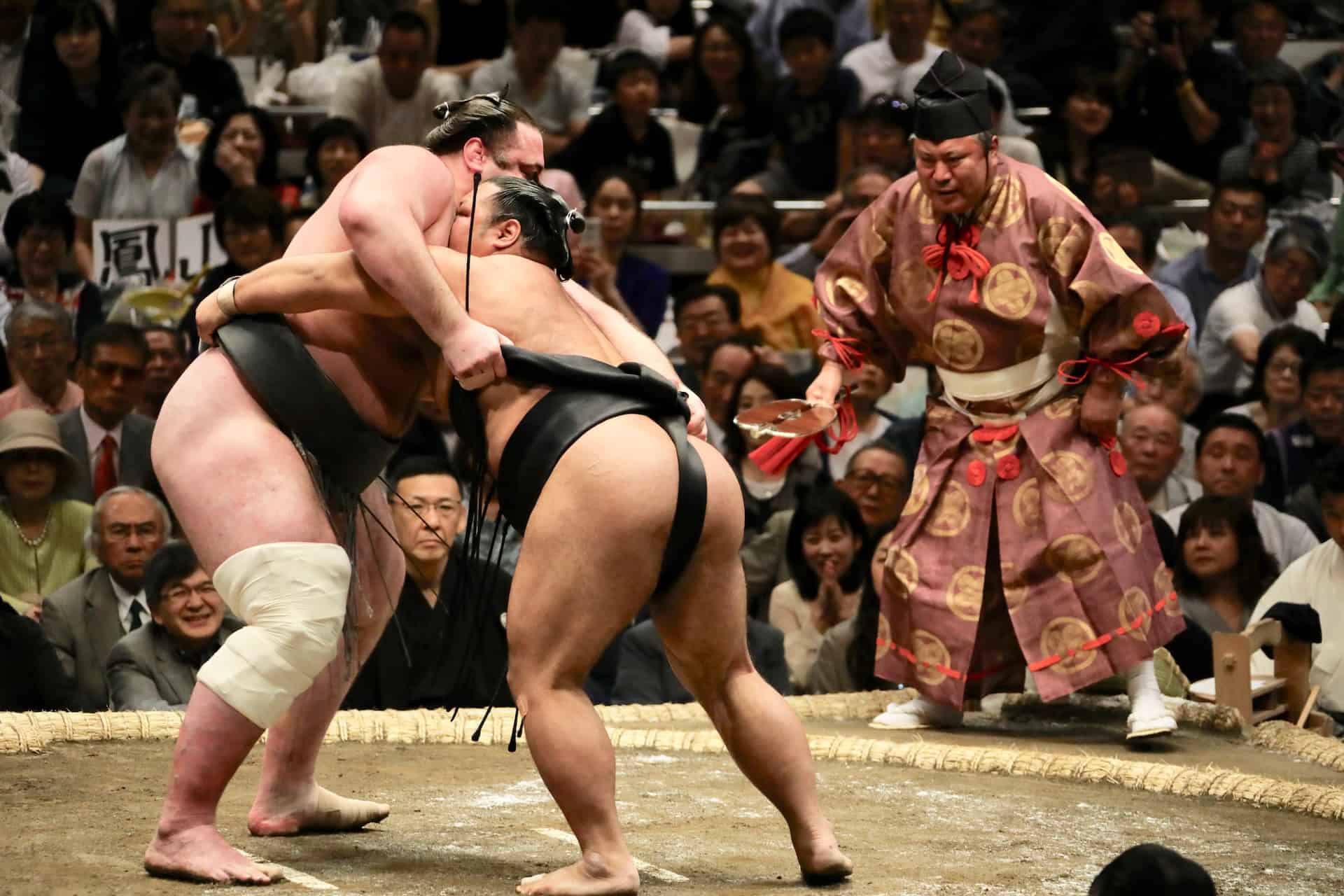
The atmosphere inside the Kokugikan is unlike anywhere else. The arena holds 11,098 spectators, the air smells faintly of chankonabe and roasted yakitori from the basement food court, and the wooden box seats (masu-seki) closest to the ring are so close you can see the sweat fly when a 160 kg wrestler is thrown to the clay. Above the ring hangs a suspended Shinto roof (tsuriyane) modeled on a shrine, weighing six tonnes. Even before the bouts begin, you understand that this is something more than sport.
Tokyo hosts three of Japan's six annual honbasho. Each runs for 15 consecutive days, starting on the second Sunday of the month and finishing on the fourth Sunday (senshuraku, the day of the final bouts).
The Kokugikan offers four distinct seating zones, each with a very different experience. Choose based on budget, comfort tolerance, and how close you want to be to the ring.
| Seat Type | Price (approx.) | What You Get |
|---|---|---|
| Tamari-seki (ringside) | ¥20,000–¥50,000+ | Cushion seating directly at ringside. So close you can be hit by a falling wrestler. Reserved primarily for sponsors — rarely sold to the public. |
| Masu-seki (box seats) | ¥10,000–¥25,000 | Traditional 1.3m square tatami boxes seating four. Shoes off, cushions on. Bento and beer delivered to your box. |
| Arena chair seats | ¥3,800–¥14,800 | Western-style seating in the upper tiers. Comfortable for the 4-6 hour day, with clear views across the arena. |
| General admission | ¥2,200 | Same-day only, sold from 8:00 a.m. Limited to ~300 tickets. Queues form by 5:00 a.m. The cheapest way into the Kokugikan. |
Doors open at 8:00 a.m. and the first bouts begin at 8:30 a.m. with the lowest division (jonokuchi). The action progresses upward through the divisions as the day unfolds, peaking with the top-division (makuuchi) matches from 3:30 to 6:00 p.m. Most casual visitors arrive around 2:00 p.m. and stay through to closing, but serious fans come early to watch the up-and-coming wrestlers in the lower divisions — the arena is mostly empty, you can sit wherever you want until the rightful ticket-holders arrive, and you witness future yokozuna at the start of their careers.
Around 3:45 p.m. comes the most photogenic moment of the day: the dohyo-iri, the ring-entering ceremony, when the top-division wrestlers enter the ring wearing their elaborately embroidered ceremonial aprons (keshou-mawashi). Each apron costs tens of thousands of dollars and is sponsored by a patron, a company, or a hometown. The yokozuna performs a separate, more elaborate ring-entering ceremony immediately afterward.
The day closes with the yumitori-shiki, the bow-twirling ceremony performed by a designated lower-ranked wrestler, signaling the end of competition. As you leave, the announcer reads the next day's matchups over the speakers, and the crowd files out into the chill of a Ryogoku evening.
You're allowed to bring outside food and drink into the Kokugikan, and most Japanese fans take full advantage. The traditional choice is an ekiben (station bento) bought from the dedicated sumo-themed bento counters at Ryogoku Station before entering. Inside the arena, the basement food court sells yakitori, oden, sumo-shaped sweets, and yes — chankonabe by the cup. Beer, sake, and soft drinks are sold by uniformed vendors who walk the aisles.
Bring layers. The arena temperature is comfortable, but the contrast with outside (snow in January, humidity in September) is significant. Cushion (zabuton) seats can get hard after several hours — an extra layer to sit on helps if you're in a masu-seki box.
Official ticket sales open roughly six weeks before each tournament. The exact date is announced on the Japan Sumo Association website. Premium seats and weekend masu-seki boxes sell out within hours. Same-day general admission goes on sale at 8:00 a.m. each tournament day at the Kokugikan box office.
Yes. There are no age restrictions. However, the day is long (8+ hours from open to close) and the upper-division bouts that most kids find exciting don't begin until mid-afternoon. Arriving at 2:00 p.m. is usually the sweet spot for families.
Inside the arena, there is no commentary in any language — only the announcer calling matchups in classical Japanese. Free English-language audio guides are sometimes available to rent at the entrance. NHK World streams English commentary online for those watching from outside the arena.
No. Casual clothes are fine. Most spectators wear smart-casual. The only requirement is that you remove your shoes when entering a masu-seki box seat.
The bouts and rules are identical — the difference is timing, weather, and atmosphere. Hatsu (January) has New Year ceremonial flourishes. Natsu (May) is the most comfortable weather-wise. Aki (September) often determines yokozuna promotions before the year ends.